
- News
RERF Holds 53rd Scientific Advisory Committee Meeting
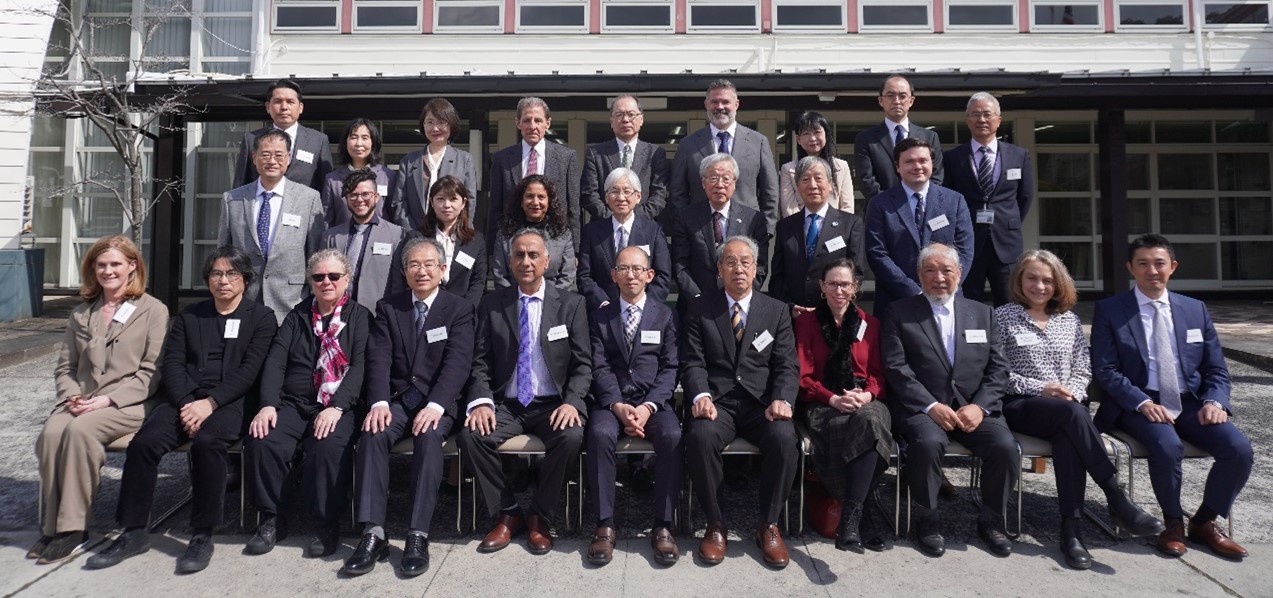
The 53rd meeting of the Scientific Advisory Committee (SAC) was held over three days, March 4–6, 2026 (Japan Standard Time), at the RERF Hiroshima Laboratory. The SAC is a body made up of outside experts that reviews ongoing studies and research being conducted at RERF and provides recommendations for approval of new research plans and continuation or modification of existing projects.
At the March meeting, a total of 12 members participated: nine Scientific Advisory Committee members from Japan and the United States and two Special Scientific Advisors. Also in attendance were observers from Japan’s Ministry of Health, Labour and Welfare (MHLW), the U.S. Department of Energy (DOE), and the U.S. National Academy of Sciences (NAS), as well as members of the RERF Board of Councilors.
This year’s Scientific Advisory Committee meeting concentrated its deliberations on hematopoietic tumors (blood cancers), the Trio Genome Study, which was announced at a press conference late last year, and the Research Resource Center, currently under preparation.
On the first day of the meeting, March 4, following opening remarks by RERF Chair Dr. Kenji Kamiya, RERF Vice Chair Dr. Preetha Rajaraman presented an overview of the organization’s research strategy. That was followed by a review of the analysis of the mechanisms underlying hematopoietic tumor development, a progress report on the Trio Genome Study, and a discussion involving the Research Resource Center.
On the second day, March 5, discussions were held between the Scientific Advisory Committee and each department regarding their research activities and related matters.
On the final day, March 6, the Committee prepared its recommendations based on the discussions held during the meeting and provided an overall summary. A press conference was then held, attended by representatives from 12 media organizations.
At the beginning of the press conference, the Japanese co-chair, Dr. Tatsuhiko Imaoka, Director, Department of Radiation Effects Research, Institute for Radiological Science, National Institutes for Quantum Science and Technology, and the U.S. co-chair, Dr. Nilanjan Chatterjee, Bloomberg Distinguished Professor, Department of Biostatistics, Bloomberg School of Public Health and Department of Oncology, School of Medicine, Johns Hopkins University, provided to the media a summary of the discussions held over the three days.
An overview of the discussions of the Scientific Advisory Committee and a list of participants are provided below.
Overview of Scientific Advisory Committee deliberations
- RERF’s research studies have been supported by the cooperation of A-bomb survivors and their children and are conducted on the basis of a relationship of trust between the study participants and RERF.
- RERF’s research results have contributed significantly to the improvement of the health and well-being of survivors and to the formulation of policies in Japan and overseas, including the creation of scientific evidence underlying radiation protection standards.
- This fiscal year marks 80 years since the atomic bombings and the 50th anniversary of the establishment of RERF. In addition to holding commemorative ceremonies, RERF has enhanced its presence both in Japan and internationally this year by disseminating information to A-bomb survivors, the local populations, and the academic community through commentaries and special issues in leading scientific journals.
- The occurrence of hematological malignancies is one of the health effects caused by radiation exposure, and RERF has focused its efforts on elucidating the mechanisms involved. While tumors are caused by genetic changes in cells, recent advances in genetic analysis technology have enabled the investigation of genetic changes that occurred long before the diagnosis of a tumor. RERF has incorporated this technology to clarify which cells with genetic changes are present in the blood of radiation-exposed individuals and how those cells might lead to the development of diagnosable tumors. These results are expected to lead to an understanding of the mechanisms by which radiation exposure causes hematological malignancies as well as to the development of technologies to identify such risks in advance.
- The Trio Genome Study is exceptionally innovative research that can only be conducted at RERF anywhere in the world. RERF has spent approximately 10 years formulating detailed research plans, establishing experimental procedures, creating a robust framework for cooperation inside and outside the foundation, providing thorough explanations to study participants and acquiring informed consent, obtaining approval from the organization’s Institutional Review Board, and actively providing sufficient explanations to A-bomb survivors and other stakeholders, as well as to society in general, including citizens. At last year’s meeting, the committee confirmed that preparations were ready for initiation of full-scale analysis. This year, it was reported that the full-scale Trio Genome Study had commenced, with the acquisition of informed consent being accelerated and a support system for research participants and a framework for collaboration with society established.
- Regarding the RRC, RERF stores a variety of invaluable information and biosamples collected through the cooperation of A-bomb survivors and their children, including varied epidemiological data, clinical data, radiation-dose information, and pathological specimens. The SAC confirmed the status of RERF’s efforts to organize and centralize these materials and information under the auspices of this center. We anticipate that RERF will continue to organize and utilize these important materials and information.
- As for the status of preparations for the high-throughput genotyping study, it is known that there are diverse individual differences among people, and part of that diversity stems from genetic differences between individuals. Much remains unknown about how such genetic diversity relates to health effects of radiation exposure. RERF is proceeding with research to investigate these genetic differences using stored biosamples obtained from A-bomb survivors, with the status of this research reported at the meeting.
- The committee confirmed that progress has been made in the proactive recruitment of personnel under the current leadership at RERF. This is very timely for RERF as it begins large-scale research projects that require cooperation among research departments.
- RERF is scheduled to relocate to the campus of Hiroshima University in early 2027. We hope the relocation will lead, naturally, to further collaborative research with Hiroshima University as well as enhanced collaborative research with Nagasaki University and that discussions regarding RERF’s future vision will proceed accordingly.
- We anticipate that RERF’s research activities will continue to contribute to the health and well-being of A-bomb survivors, their children, and all of humanity.
Participants of the Scientific Advisory Committee meeting
- SCIENTIFIC ADVISORS
- Dr. Nilanjan Chatterjee, Bloomberg Distinguished Professor, Department of Biostatistics, Bloomberg School of Public Health and Department of Oncology, School of Medicine, Johns Hopkins University (Co-chair)
- Dr. Tatsuhiko Imaoka, Director, Department of Radiation Effects Research, Institute for Radiological Science, National Institutes for Quantum Science and Technology (Co-chair)
- Dr. Patrick Concannon, Professor Emeritus, Department of Pathology, Immunology and Laboratory Medicine, College of Medicine, University of Florida*
- Dr. Yoshiya Shimada, President, Institute for Environmental Sciences
- Dr. Montserrat Garcia-Closas, Professor of Epidemiology and Group Leader, The Institute of Cancer Research
- Dr. Melissa Haendel, Director of Precision Health & Translational Informatics; Sarah Graham Kenan Distinguished Professor; Professor of Genetics and Pediatrics, School of Data Science and Society; Deputy Director of Computational Science, NC TraCS, University of North Carolina at Chapel Hill; and Advisor for Research Data Interoperability, UNC Health System
- Dr. Fumihiko Matsuda, Director, Center for Genomic Medicine, Kyoto University Graduate School of Medicine
- Dr. Gen Suzuki, Medical Doctor, Honaigo Medical Clinic, Honaigo Koseikai Medical Corporation
- Dr. Gayle Woloschak, Professor, Department of Radiation Oncology, the Feinberg School of Medicine, Northwestern University
- Dr. Seiichiro Yamamoto, Professor, Shizuoka Graduate University of Public Health; Specially Appointed Researcher, National Cancer Center Japan
- *Online participation
SPECIAL SCIENTIFIC ADVISORS- Dr. Koichi Takahashi, Associate Professor, Department of Leukemia, Division of Cancer Medicine, The University of Texas MD Anderson Cancer Center
- Dr. Kelly Bolton, Assistant Professor of Medicine, John T. Milliken Department of Medicine, Division of Oncology, Washington University
OBSERVERS- Ms. Hitomi Hori, Director, Atomic Bomb Survivors’ Support Office, General Affairs Division, Public Health Bureau, Ministry of Health, Labour and Welfare
- Dr. Joey Zhou, Senior Epidemiologist, U.S. Department of Energy
- Dr. Cato Milder, Japan Program Manager, Office of Health Studies and Former Worker Programs, Office of Environment, Health, Safety and Security, U.S. Department of Energy
- Dr. Daniel Mulrow, Program Officer, Nuclear and Radiation Studies Board, National Academies of Sciences, Engineering, and Medicine
- Dr. Ryugo Hayano, Emeritus Professor, The University of Tokyo (RERF Councilor)
RERF- Dr. Kenji Kamiya, Chair/Representative Director
- Dr. Preetha Rajaraman, Vice Chair and Executive Director
- Dr. Kazunori Kodama, Executive Director
- Dr. Todd DeWees, Chief Scientist
- Dr. Osamu Tanabe, Chief Scientist/Director of Biosample Research Center
- Mr. Satomichi Kaneoka, Chief of Secretariat