
- News
Trio Study Using Genome Analysis
STUDY SUMMARY
Following careful preparation and ethical review, RERF will initiate the Trio Genome Study.
After nearly 10 years of careful preparation under the guidance of leading experts in Japan and abroad, the Radiation Effects Research Foundation (RERF) is now initiating a genome sequencing study involving atomic bomb (A-bomb) survivors and their children. Through this study, we would like to gain a deeper understanding of whether radiation exposure experienced by parents could affect the DNA (genome) of their children. The study will be conducted in accordance with the highest scientific and ethical standards. In this study, the wishes of the study participants will be given the highest priority, and strict protection of personal information will be ensured.
Human cell DNA consists of about three billion pairs of bases called nucleotides (A, T, C, and G), with one set inherited from each parent. When DNA is passed from parents to children, about 50 to 100 new DNA changes (“de novo mutations”) naturally occur in every individual. Therefore, over the course of human evolution, individual differences have emerged in approximately 0.1% (1/1,000 base pair) of the three billion base pairs in the DNA. These differences explain why people vary in facial features, height, hair color, eye color, and even how they perceive taste (genetic diversity).
Previous studies have shown that factors such as parental age at conception, parental smoking history, and exposure to chemical agents can be associated with an increased number of new DNA changes in their children. However, the effects of parental radiation exposure on the DNA sequences of their children have not yet been clarified.
This study examines the number of new DNA changes that are present in children of A-bomb survivors but not in their parents. To accomplish this, we analyze the DNA of groups of three people—a father, a mother, and their child—called “trios.” We then compare the number of new DNA changes in children of parents who were exposed to high-dose radiation with the number of new DNA changes in children of parents who were exposed to very little or no radiation.
This study is designed to build basic scientific knowledge about whether parental radiation exposure can influence the DNA sequences (genome) of the offspring at the population level. The findings are expected to contribute to future studies in this field.
However, it is scientifically impossible at this time to tell whether a specific DNA change in an individual is caused by radiation or occurs naturally. Therefore, this study cannot determine whether individual study participants are more likely to develop specific diseases due to radiation.
Although it is not the main goal of the study, in very rare cases, analyzing DNA may identify DNA variants in parents or children that could be related to disease. Previous medical research has shown that DNA variants reported to be associated with disease are very rare, and their cause is not yet known. If such variants are found and considered medically important, and if the participant wishes to know, the information may be shared with him/her. In these cases, results will be provided only after confirming the participant’s wishes and only when the information is judged to be helpful for his/her personal health management.
Comments from External Advisors
The Radiation Effects Research Foundation has spent considerable time examining the ethical and social issues associated with this study, in collaboration with experts both in Japan and abroad. The Foundation has also engaged in repeated dialogue with atomic bomb survivors and their children, striving to foster understanding and build trust regarding the study. We anticipate that this study will generate further important new insights, building upon the Foundation’s long-term research achievements.
(Dr. Kazuto Kato, Professor, Graduate School of Medicine, Osaka University; co-Chair, RERF external ELSI & Social Co-Creation Committee)
The planned Trio Study will provide essential information that will greatly contribute to future research on the effects of radiation exposure on successive generations, which is also a critical issue in genomic medicine. RERF is the world’s only institution capable of conducting such studies on an epidemiological scale, and we anticipate outstanding scientific findings that will attract global attention.
(Dr. Fumihiko Matsuda, Professor and Director, Center for Genomic Medicine, Graduate School of Medicine, Kyoto University; expert advisor, RERF external Scientific Advisory Committee)
STUDY APPROACH
(2) Sequence Genomes. Use laboratory machines to read and record the DNA sequence for each participant.
(3) Identify Any New Genomic Changes. Compare the genomes of children with their parents and count the number of new DNA changes in the child.
(4) Compare By Parental Radiation Dose. Compare groups to see whether the number of DNA changes in children is different between families where one or both parents had high radiation doses from the atomic bomb, compared to families where parents had very little or no radiation dose.
ETHICS AND SOCIAL ENGAGEMENT
At RERF, we do our research in accordance with the Ethical Guidelines for Life Science and Medical Research Involving Human Subjects, established by the Ministry of Education, Culture, Sports, Science and Technology; the Ministry of Health, Labour and Welfare; and the Ministry of Economy, Trade and Industry. For this study, we provide a clear explanation of the research to eligible individuals and request their informed consent after making sure they fully understand our study. Participants may withdraw from this study at any time. We prioritize building better studies together through ongoing dialogue with atomic bomb survivors, their children, and members of the public to foster a relationship of mutual understanding and trust in RERF research. To date, we have been open with the public about our study by holding public lectures, organizing briefings for study participants, and discussing the project with visitors at RERF Open House events. In addition, we created an External Advisory Committee to hear opinions from outside perspectives and gather expert advice from multiple viewpoints including atomic bomb survivors and their families. We also created the Ethical, Legal, and Social Issues and Social Co-Creation Committee to get advice from experts from outside RERF on important topics like genome research, research ethics, and genetic counseling. We will continue to engage the public with events and information sharing and will make every effort to communicate our study’s goals and findings in clear and understandable ways. If you would like more detailed information on ethical guidelines for research involving human subjects, please refer to the following websites:
- Ministry of Health, Labour and Welfare: Guidelines for Research
- Ministry of Education, Culture, Sports, Science and Technology
PROTECTING PARTICIPANTS’ PERSONAL INFORMATION AND CHOOSING NOT TO PARTICIPATE
At RERF, we take protecting participant’s personal information very seriously. We may publish study results in scientific journals or present at academic conferences; however, no personally identifiable information—such as participants’ names or addresses—will ever be disclosed. If you do not wish for your samples or information to be used in this study or have any questions about the study, please contact us using the information in the QUESTIONS? section at the bottom of this page. Making an inquiry or choosing not to participate will not result in any disadvantage.
FREQUENTLY ASKED QUESTIONS
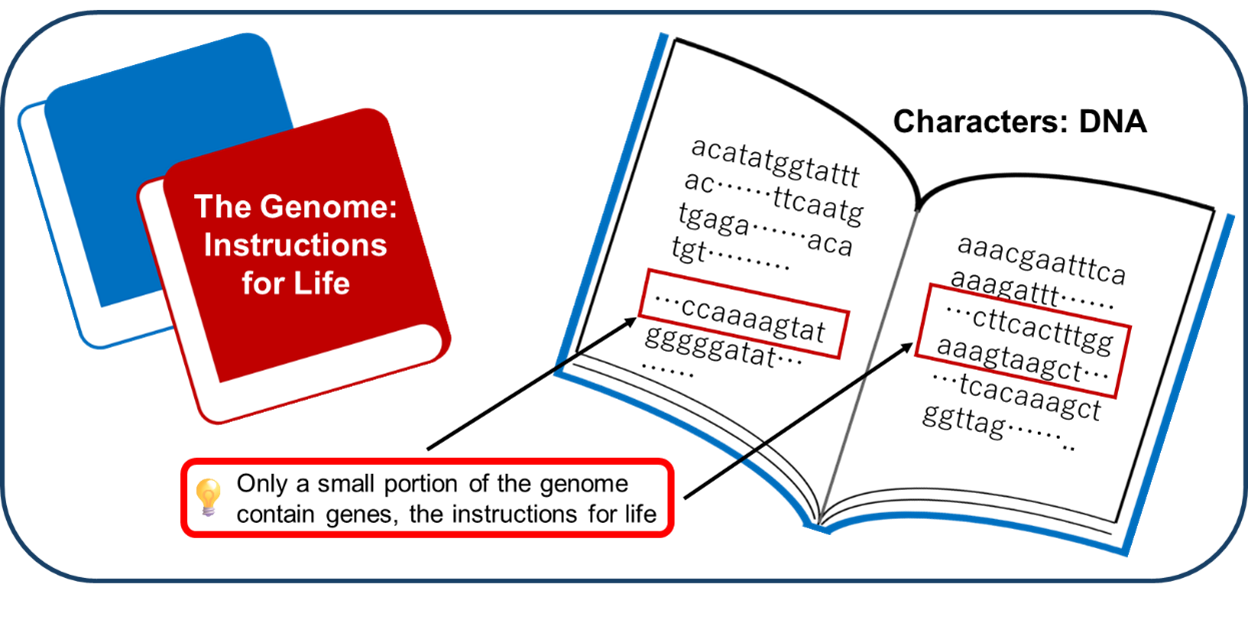
A. Each of the 37 trillion cells that make up our bodies contain a molecule with the instructions to make the building blocks needed for life. This molecule, called DNA, is made up of smaller molecules called nucleotides. Each of our cells contain DNA corresponding to about three billion base pairs and the complete set of this DNA is called our genome. We can think of each nucleotide as an individual letter in a book. When many letters are arranged in a long sequence, they form DNA, and all of this DNA together is called the genome. Sections of DNA that contain information for unique characteristics, such as determining eye color or blood type, are called genes. Interestingly, only about one to two percent of the genome is organized into genes.
Q. What types of parent–child combinations are included in this study?
A. In this study, each family is studied as a set of three people—a mother, a father, and their child. Because a group of three is referred to as a “trio” in English, this project is also called the “Trio Genome Study.” This study includes children of parents who were highly exposed to radiation and children of parents who were exposed to very little or no radiation.
Q. How are personal information and genome data protected?
A. We strictly manage personal information and genome data so that researchers cannot identify participants from the data. Personal information such as the names and addresses of all participants are removed from samples and study information. Each participant is assigned a “research ID number” that researchers use instead of the participant’s name or other personal information. In addition, only authorized people with special permission can access the data. No participant personal information that could identify an individual is included in published research findings.
Q. How will study results be shared with society and used in the future?
A. We will share our study results with the public in scientific papers and reports. These publications will summarize results that describe overall trends and won’t present individual results. We will make sure this information is clear and accessible information so that participants, their families, and the public can easily understand the results. We hope the study results contribute to society by informing discussions on radiation safety standards, as well as informing research in medical, educational, and other relevant fields.
Q. This study analyzes large DNA sequences to look for new mutations in a child’s genome. In general, what percentage of DNA changes can potentially cause disease? Are these DNA changes the result of parental radiation exposure?
A. Human DNA is made up of about three billion building blocks consisting of pairs of nucleotides (A, T, C, and G). When DNA is passed from parents to children, about 50 to 100 new DNA changes naturally occur in every individual. Therefore, over the course of human evolution, small differences have emerged in about 0.1% of our DNA. These differences explain why people vary in facial features, height, hair color, eye color, and even how they perceive taste. This natural variation is called genetic diversity.
It is not possible to tell whether a specific DNA change in an individual was caused by radiation or occurred naturally.
PROGRESS AND PAST ACTIVITIES
- December 23, 2025:Press Conference Held to Announce Launch of “Trio Study Using Genome Analysis”
- 2025: Ethical, Legal, and Social Issues (ELSI) Regarding Return of Results for Genome Studies of Atomic Bomb Survivors
- August 5, 2025: Parental Exposure and the Health of Children—An Introduction to RERF’s New Research
- May 26, 2025: Announcement of Agreement on Research Collaboration with Nagasaki University Hospital
- April 24, 2025: Signing of Collaborative Research Agreement with Hiroshima University Hospital—Radiation Effects Research Foundation (RERF)
- December 12–13, 2024: RERF Holds International Symposium on Ethical, Legal, and Social Issues (ELSI) regarding Return of Results for Genome Studies of Atomic Bomb Survivors
- November 29, 2024: Study Meeting with Hiroshima Media
- August 8, 2024: Explanatory Meeting at Nagasaki Laboratory Open House: “Parental Exposure and the Health of Children—An Introduction to RERF’s New Research”—Held Twice
- August 5–6, 2024: Explanatory Meeting at Hiroshima Laboratory Open House: “Parental Exposure and the Health of Children—An Introduction to RERF’s New Research”—Held Four Times
- July 27, 2024: Explanatory Meeting for Nagasaki Study Participant
- April 20, 2024: Public Lecture in Nagasaki: “Parental Exposure and the Health of Children—An Introduction to RERF’s New Research”
- April 13, 2024: Public Lecture in Hiroshima: Parental Exposure and the Health of Children
- April 6, 2024: Explanatory Meeting for Hiroshima Study Participants—Held Twice
- October 27, 2023: Second Media Study Session
- October 13, 2023: First Media Study Session
- August 23, 2023: Second Meeting of External Advisory Committee on Biosample Usage held at RERF
- June 1, 2023: First Meeting of External Advisory Committee on Biosample Usage held at RERF
- May 25, 2023: Approval of Research Protocol by Ethics Review Committee
- August 12, 2022: Stakeholder Committee on Genome Sequencing Analysis for A-bomb Survivors’ Children submits advice to RERF
- April 9, 2022: Fifth Stakeholder Committee on Genome Sequencing Analysis for A-bomb Survivors’ Children—Remote Session
- February 6, 2022: Fourth Stakeholder Committee on Genome Sequencing Analysis for A-bomb Survivors’ Children—Remote Session
- November 6 and 17, 2021: Third Stakeholder Committee on Genome Sequencing Analysis for A-bomb Survivors’ Children—Two-Day Remote Session
- August 21 and 25, 2021: First Stakeholder Committee on Genome Sequencing Analysis for A-bomb Survivors’ Children—Two-Day Remote Session
- April 20, 2021: Establishment of Stakeholder Committee on Genome Sequencing Analysis for A-bomb Survivors’ Children
QUESTIONS?
Make sure to visit this page for future news and updates regarding this research! If you have any comments or questions regarding the study, please send them to the email address below.